
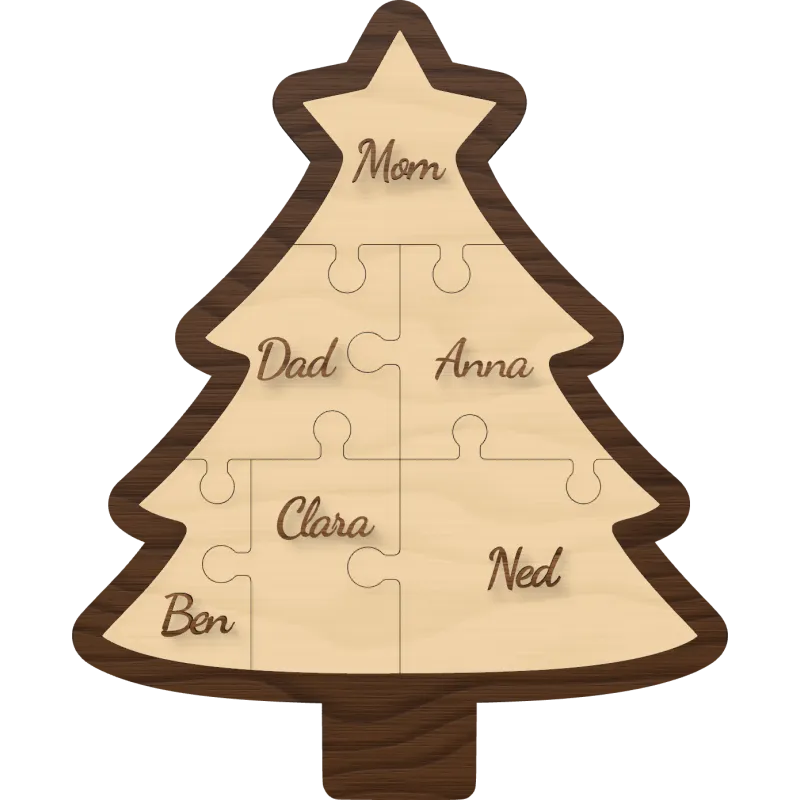


The 3D view isn’t available right now. Here is the top view.
The app was updated. Reloading the page…
Its files couldn’t be loaded. Reload the page; if that doesn’t help, check your connection.
Your browser can’t start WebGL right now. The 3D view comes back by itself once it can; if it doesn’t, restart the browser (Chrome switches WebGL off after a graphics crash) and check that hardware acceleration is on.
Your browser can’t start WebGL right now. Restarting the browser usually helps (Chrome switches WebGL off after a graphics crash); also check that hardware acceleration is turned on.
It stopped with an error. Try again; if it keeps happening, reload the page.
Details
The cutting plan appears once the preview is ready.
The cutting plan can’t be built right now. The 3D view still shows your design.
Cut Score No score lines Engrave Gluing guide
About this laser cut file
Three tiers and a star are cut into one jigsaw piece per name, and the trunk stands on the walnut tray below them.
Made as One piece, without the tray, the trunk becomes part of the puzzle.
It makes a keepsake for a first Christmas in a new home, a present for grandparents with every grandchild on it, or a holiday activity for the kids.
How it works
-
Type one name per line: the first goes on the top left piece, the others follow row by row.
-
Add blank pieces for a family that is still growing, and shuffle the tabs until the pattern suits you.
-
Pick Layered for a tray with a back plate and a frame, or One piece; cut apart or scored; then set the width.
-
Download the SVG and cut the pieces; for Layered, glue the frame onto the back plate and lay the pieces in.
What’s in the file
- Cut lines: every piece in its place, or the whole puzzle as one piece; for Layered also the back plate and the frame of the tray.
- Engraving: each name filled in, or only its outline as score lines.
- Score lines, for a scored puzzle: the joints between the pieces with their tabs.
- An optional gluing guide for Layered: the frame’s place on the back plate.
- SVG for every laser: the cut lines red, the score lines and the engraving blue, the gluing guide green, each on a layer of its own, true to size.
- PNG for raster engraving: the engraving alone - the score lines, the engraved areas and the gluing guide black on transparent at 600 dpi, as large as the sheet, so imported true to size it lies exactly on the SVG’s cut lines.
- PDF to print and proof: the same lines as vectors, true to size, every kind of line on a layer of its own - printed at 100 %, it shows the real size.
- AI for Illustrator: the same file as the PDF, which Illustrator opens as its own document, every kind of line on a layer of its own.
- DXF for CAD programs and RDWorks: the lines on the layers CUT, SCORE, ENGRAVE and GUIDE, in mm.
- STL to 3D print the design: the pieces as solids at their thickness - with several parts a ZIP with the whole piece and one STL per part.
- With Batch, several puzzles at once: a ZIP with one file per puzzle, or one sheet with all of them.
Questions
What if the family has many names?
The tree takes up to 48 pieces. From about a dozen names, choose a width of 11.81 in or more so every name stays easy to read on its piece.
How many pieces will there be?
One per name you type, between 2 and 48, plus any blank pieces you add under “Pieces”. The grid is chosen so the pieces come out about the same size, and bits at the edge too small to hold join a neighbor.
Cut apart or scored: which should I pick?
Cut apart gives a real puzzle that comes to pieces and goes back together. Scored keeps it in one piece with the joints engraved as thin lines, so it can hang or stand like a sign.
Where does each name go?
In the order of your list, row by row from the top left. Each name is set as large as its piece allows, clear of the tabs, and an empty line keeps a piece blank. Under “Construction” choose engraved, cut out or glued on raised.
How large is it?
It starts 7.87 in wide and goes from 3.15 in to 1 m; the height follows the shape. The tabs grow with the pieces, but their necks stay at least 0.14 in wide and the tray’s border keeps its width.
Can I make one for every name on a list?
Yes. Choose “Batch” above the first text and paste your list, one piece per line, up to 100. Every line becomes its own piece: download a ZIP with one file each, or one sheet with all of them.


